2025–2026 in review

Utilities Disputes has a simple and clear purpose – to sort complaints between utility providers and consumers through prevention, education and dispute resolution. We are independent and free to all consumers, and our mission is to be fast, fair and effective.

A message from the Chair

Tautohetohe Whaipainga | Utilities Disputes (UDL) is Aotearoa New Zealand’s leading dispute resolution provider for utility companies and their customers. We resolve complaints about electricity, gas, water, fibre installation on shared property and telecommunications. In the last year, we’ve helped a record number of people and it’s a privilege to be able to share the amazing mahi we do every day for all Kiwis.

Working with consumers and utility companies gives us a unique insight into the sector. Consumers share their stories, issues and concerns. We resolve complaints, sort issues and convert the stories we hear into data which can be used to shine a light on issues, so solutions can be found.

We are committed to delivering a dispute resolution service that provides an outstanding service to consumers and companies, and genuine value to New Zealand.

The last 12 months has seen a number of challenges for the utility sector. The energy landscape is changing as electrification gathers pace, our gas supply is in decline and energy hardship is continuing to rise. Generational change is happening in the water sector, and more and more consumers are choosing to bundle their energy and telecommunications service. In the past year we have helped over 25,000 Kiwi utility consumers and companies navigate these issues in a fast, effective and empathetic way.

A message from the Commissioner

In the past year we have responded to a surge in demand for our services, successfully supporting consumers and utility companies to resolve their issues and restore the trust that is vital to the provision of essential services such as energy, water and telecommunications.

We received 13,554 complaints, a 62% increase from the previous year, which was already a record level of demand. We responded by focusing on early resolution and improving our ability to issue decisions. We also worked hard to identify systemic issues so they can be addressed to improve utility services for everyone and prevent future complaints.

A fantastic example of this approach was our systemic investigation of catch-up bills and their impact on Kiwi households and small businesses. We provided rigorous data and decisions to highlight the issue, and engaged strategically with utility company CEOs, regulators and stakeholders and showed how consumer protection measures in other jurisdictions can be applied to New Zealand. This resulted in the introduction of a six-month cap on catch-up bills that will improve services for all electricity consumers.

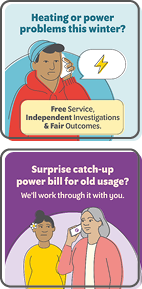
In the past year we also expanded our role and reach. We were part of two separate social media campaigns that achieved unprecedented results. Both were aimed at building awareness, so consumers know how to access our services when they need them.

Highlights

Year at a glance

Here are some of our highlights from 2025–2026.

We're resolving more complaints, and resolving them faster.

27,045

complaints and queries were received
in 2025—2026

Complaints and queries

62%
increase in the number of complaints
4,536
complaint summaries produced and sent to providers on behalf of consumers
27,000+
Kiwis contacted us to get help with our services
93%
of queries resolved within one day
91%
of complaints and queries resolved within 10 days
93%
of deadlocked complaints closed in 90 days

Systemic insights

UDL produced its second systemic insight report.

27
Commissioner decisions referred to external organisations

Systemic Insights 2025 booklet cover

Social media

19M
impressions – combined reach on social media

Social media posts

How many consumers our schemes cover

Energy

Every household and business in Aotearoa

BSPAD

Every major fibre provider and all the shared properties that rely on them

Water

Over 2 million consumers across Aotearoa

Telecommunications

Over 100,000 consumers across Aotearoa
Complaints

Complaints

Background

UDL resolves complaints between utility providers and consumers. If a consumer has made a complaint to their provider the two parties cannot resolve, they can come to UDL to get it sorted. We work with both parties to find a fair resolution.

Our process can be separated into three key streams:

  1. Intake: Our First Contact team receives all incoming complaints and queries and refers these to providers. The First Contact team will often set out a consumer’s complaint in writing, on their behalf, in a Complaint Summary – we did this for over 4,500 consumers last year.

    The First Contact Team will refer consumers to other organisations if it is not an issue we can resolve. The team will also fast track urgent complaints where the consumer may suffer serious harm, for example those involving disconnections.
  2. Deadlock: Deadlock Complaints are complaints that have already been made to the provider and remain unresolved after 20 working days (some complaints can reach deadlock without being with the provider for 20 working days, as per our Scheme Rules). These complaints are referred to our Early Resolution team. They will work with the consumer and provider to try and resolve the complaint early in the process. If it can't be resolved, we may issue a Commissioner's decision to close the complaint. If it would not be correct to close the complaint, it will be accepted for further investigation.
  3. Accepted: If the complaint has not been resolved through the above process, it can be accepted for further investigation. The Conciliation & Investigation team will then take it over. They can complete an in-depth investigation if required and they will continue to work with the complainant and provider to try and reach an agreement to resolve the complaint. Complaints reaching this stage are usually more complex and not suitable for early resolution. If they can't be resolved by agreement the Commissioner will issue a decision after deciding what is a fair and reasonable outcome.

We continue to focus our resources and efforts on resolving complaints earlier. We’ve made changes to our annual reporting to better represent this and our performance standards align with this.

This year's data is broken into four sections:

  1. The big picture
  2. Complaints – Intake
  3. Complaints – Deadlock
  4. Complaints – Accepted
1

The big picture

At a glance:

27,045
complaints and queries received
62%
increase in the number of complaints compared to last year
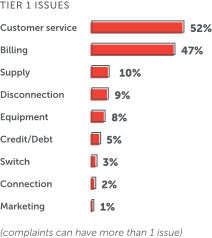
52%
of complaints involve a customer service issue


The most common customer service complaints were:

  • Getting through to the provider
  • Failure to act as agreed
  • Poor complaint handing
47%
of complaints involve a billing issue


The most common billing complaints were:

  • Disputed bills
  • Affordability issues
  • Poor complaint handling

Complaints and queries received

Complaints 13554
Queries 13491

There was a 6.5% increase in queries received, and a 62% increase in complaints. These increases reflect the difficult conditions facing many consumers last year, and the growing awareness of UDL. This continues a trend of increased complaint numbers yearly since 2019–2020.

In depth:
We are sorting more complaints than ever before. During this year we received 27,045 queries and complaints across all schemes, compared to 21,020 last year.

Complaints and queries received by scheme

Below is the breakdown of complaints and queries received by each scheme, compared to 2024–2025. These graphs also show how far into UDL’s process these complaints and queries progressed.

Energy

Energy
Complaints 12505
Queries 12413
Deadlocked complaints 1916
Accepted cases 175

Broadband Shared Property Access Disputes

Broadband
Complaints 25
Queries 13
Deadlocked complaints 12
Accepted cases 12

Water

Water
Complaints 134
Queries 27
Deadlocked complaints 26
Accepted cases 9

Telecommunications

Telecommunications
Complaints 263
Queries 429
Deadlocked complaints 17
Accepted cases 0

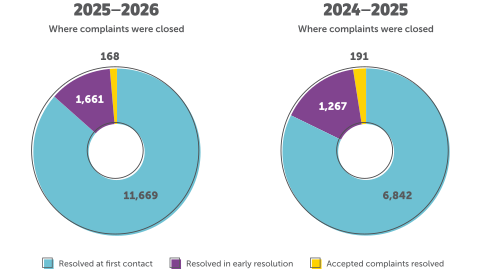
Where complaints are closing

The number of complaints resolved at first contact increased by 71%. The number of complaints resolved in early resolution increased by 31%, while the number of accepted complaints resolved fell. These numbers include complaints that began prior to the reporting year.

What consumers are complaining about

We have a robust and comprehensive sets of complaints data, gathered from our unique position of being the only organisation resolving complaints across all utilities. We record complaint issues in several tiers to get a clear idea of what the main issues of a complaint are, to gather insights and identify emerging trends. A single complaint can have several issues.

graph complaining about
2

Complaints – Intake

Every case received by UDL starts at intake with our First Contact team.

At a glance:

27,045
complaints and queries received

(21,020 in 2024–2025)

13,554
complaints received

(8,356 in 2024–2025)

53%
increase in the number of Complaint Summaries produced

In depth:

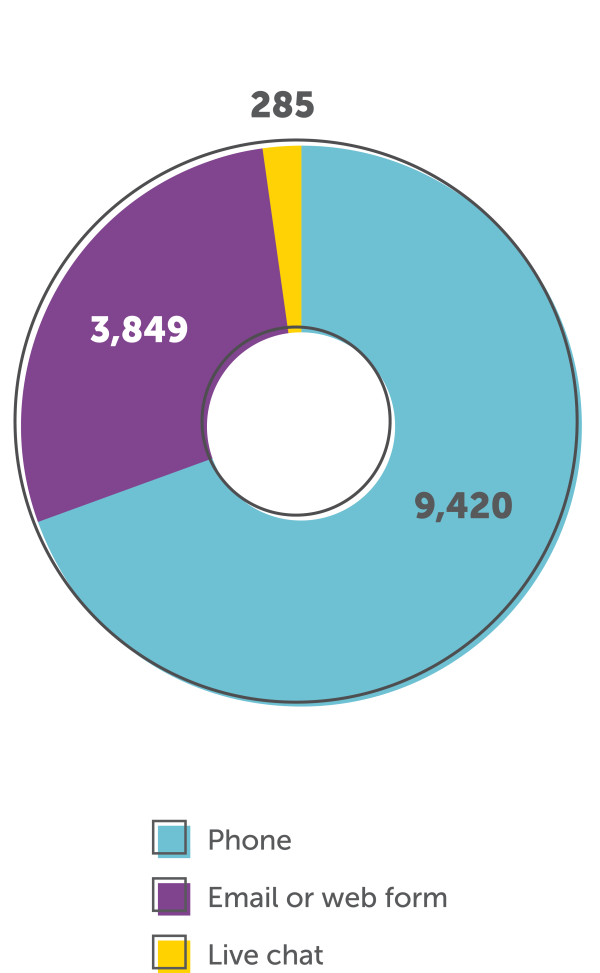
How complaints are received

Pie graph showing 285 live chat, 9,420 phone and 3,849 email or web form

Complaint Summaries

One way we provide value at intake is by producing Complaint Summaries for consumers. These are written summaries of a consumer’s complaint that is passed on to a provider’s complaint resolution team by UDL. They set out the details of a complaint succinctly and confirm the resolution the consumer is seeking. Complaint Summaries help resolve complaints early by identifying the issues for both sides so they can focus on resolving them. They also reduce the stress in complaining – one of the barriers that prevents people from getting issues sorted.

Complaint Summaries are valued by consumers and providers. This can be seen from the increased NPS score for complaints where Complaint Summaries were provided.

4,536
complaint summaries written

Resolutions

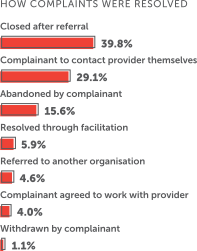
A crucial responsibility of the First Contact team is to identify which complaints need to be escalated. This typically happens when there is a potential disconnection or potential for the consumer to suffer serious harm. Where appropriate, the team will refer complainants to external organisations or provide a Complaint Summary so the complainant can first try and resolve the issue with their provider.

86.5%
of all complaints closed were resolved by the First Contact team

graph intake complaints resolved
3

Complaints – Deadlock

At a glance:

1,972
complaints that reached deadlock

(1,502 in 2024–2025)

31%
increase in the number of deadlocked complaints
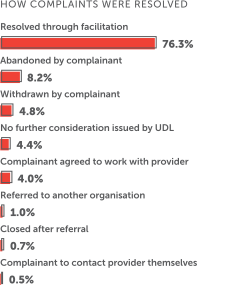
76.3%
of closed deadlocked complaints were resolved through facilitation

In depth:

A complaint reaches deadlock once it has been with the provider for 20 working days, or it would be otherwise inappropriate to wait longer.

Resolutions

When a complaint reaches deadlock, we will first try and resolve the complaint through facilitation. If we are unable to resolve it early, we may accept the complaint for further consideration.

Deadlocked complaints increased by 31%, with the likelihood of a deadlock complaint being accepted decreasing by 2.3%. This coincided with a 12% increase in the number of Commissioner decisions.

10%
of deadlocked complaints accepted
(12.3% in 2024–2025)

12.3%
of all complaints closed were resolved by the Early Resolution team

graph deadlock complaints resolved
4

Complaints – Accepted

At a glance:

196
complaints accepted

(174 in 2024–2025)

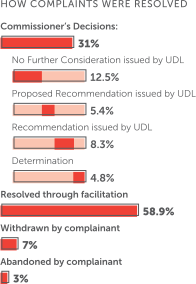
31%
of accepted complaints were resolved by Commissioner’s Decision
12.6%
increase in the number of complaints accepted

In depth:

Resolutions

If a complaint needs further investigation, we can accept it for consideration by the Conciliation and Investigation team. This team will still try and facilitate a solution and will also investigate the issues.

graph accepted complaints resolved

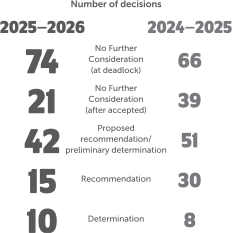
Most accepted complaints require a Commissioner’s Decision. The most common decision type is a No Further Consideration, which typically occurs when the Commissioner decides that the provider has already made a fair and reasonable offer to resolve the complaint.

The Early Resolution team can issue No Further Considerations while a complaint is at deadlock. The team will issue these when considering if a complaint should be accepted.

graph accepted number of decisions

Complaints glossary

Queries: Where a consumer is simply seeking information or assistance or has contacted us in error (thinking they were calling their provider).

Complaints and disputes: Includes an expression of dissatisfaction made to or about a provider where a response or a resolution is explicitly or implicitly expected. If the complaint is within 20 working days, we may carry out a three-way call or other dispute resolution method, provide a complaint summary or connect the consumer to their provider.

Deadlocked Complaints: A provider has 20 working days to resolve a complaint. If we are advised the complaint is not resolved after this period, it is described as being at "deadlock". At this stage we assess whether we have jurisdiction to accept it or whether there are grounds to take no further action perhaps because the provider has already made a fair and reasonable offer. A serious complaint such as a potential disconnection may be deadlocked without waiting for the 20-day period to expire. A provider is able to challenge jurisdiction when a complaint is at deadlock.

Resolved Deadlock Complaints: These are deadlocked complaints that have been resolved without being accepted. This can be for a number of reasons. An offer may have been made by the provider which the Commissioner decides provides a fair and reasonable outcome and a decision is issued to confirm this. The complaint may also be closed by agreement after UDL has facilitated a resolution.

Accepted Complaints: These are deadlocked complaints that are accepted as being within jurisdiction, suitable for investigation and are referred to the Conciliation and Investigation Team. If they cannot be resolved, the Commissioner will issue a decision.

Case studies

Non-communicating electricity meters and large catch-up bills

Modern electricity meters are incredibly accurate at recording electricity usage. However, they can sometimes have communication issues. When this happens usage data is still stored on the meter, it’s just not communicated to the provider for the relevant account. As a result, electricity providers will often estimate a customer’s usage and issue bills based on estimates.

As providers will sometimes under-estimate usage, this can result in the customer receiving a large catch-up bill when their actual usage is obtained from the meter – sometimes in a single direct debit. This increases the risk customers will suffer financial hardship and face potential disconnection. The risk of this systemic issue occurring can be reduced if providers take proactive steps to address non-communicating or incorrectly identified meters. It can also be reduced if providers make it clear when a bill is based on an estimate so the customer can provide their own meter reading to the provider.

The impact on the customer can also be reduced if providers have processes in place to identify large catch-up bills and allow customers to pay them back over time, rather than deducting them in a single transaction.

What happened

A business customer took over a factory where it opened up a gym. Unfortunately, the gym’s electricity meter was not communicating electricity usage to the provider.

The provider billed the gym on the basis of estimates for an extended period without sending a meter reader to obtain an actual read. The provider had also been underestimating the gym’s electricity use as it was relying on usage during lockdown.

When actual usage was eventually obtained, the provider issued a catch-up bill of more than $76,000 and tried to deduct this from the gym’s bank account. The customer disputed the usage and the total outstanding balance reached $93,000.

The customer believed some of the usage was related to the factory’s previous owner and raised concerns about the provider’s efforts to obtain meter readings.

What did we look at? 

We looked at whether the catch-up bill reflected the customer’s actual electricity usage during the relevant period. We also looked at whether the provider had made all reasonable efforts to obtain meter readings and to explain the risks of ongoing estimated billing.

Finally, we also considered whether it was appropriate to attempt to deduct such a large bill by direct debit without warning the customer or offering them time to pay.

What was the outcome? 

The Commissioner was satisfied the catch-up bill broadly reflected the customer’s electricity usage. He was also satisfied the provider had made genuine attempts to obtain meter readings over a lengthy period. However, the Commissioner reached the view the provider should not have attempted to debit such a large amount from the customer’s bank account without any warning or communication. The amount was many, many times more than the customer’s average bill and had the potential to cause the customer significant hardship.

The provider offered to discount the customer’s bill by 30% and offered a repayment plan so it could be paid off over time.

The Commissioner decided this was a fair and reasonable outcome. The Commissioner also took steps to ensure this systemic issue was addressed, copying his decision (and others like it) to the Electricity Authority and the Commerce Commission together with data highlighting the extent of the issue and restrictions in place to limit catch-up billing in the UK and Australia.

Regulatory change

This has led to the Electricity Authority consulting on similar restrictions in Aotearoa | New Zealand and to restrict catch-up bills to six months from 30 October 2026.

Names and details have been changed for privacy reasons.

Solar contracts, returns and exit costs

Solar subscription contracts can come with long-term commitments, significant costs and termination fees if customers seek to terminate the arrangement in advance. Customers are often unsure whether they are ‘realising’ the promised returns through their solar equipment and there can also be confusion about who is their provider for the electricity from solar and the electricity grid.

In this case, a customer entered into a solar and battery subscription agreement with a solar provider for an extended period of time. As part of that agreement the customer essentially had two electricity providers: 1. the solar provider for the solar generated from his solar equipment 2. another traditional electricity provider for usage from the electricity grid when insufficient solar was being generated by his solar system.

After the solar system was installed, the customer became concerned their electricity bills had increased and asked the solar provider to remove the solar equipment. The solar provider was prepared to let the customer exit the agreement but said he would have to pay installation and removal costs of approximately $9,000. The customer didn’t believe the high exit costs were legitimate, and raised issues in relation to the potential impact the solar equipment had had on his property’s roof, which he said had not been fully explained when he signed the agreement.

What did we look at?

Utilities Disputes reviewed the customer’s electricity usage and confirmed the promised returns were being delivered by the solar system that had been installed. While it was correct the customer’s electricity bills had increased that was due to higher overall usage and the customer’s decision to sign up with a new electricity provider for the electricity used from the grid. This shift in electricity provider meant he was not following the savings model set out in the contract with their solar provider.

What was the outcome?

The Commissioner considered whether the solar provider met its contractual obligations, both in terms of law and industry guidelines and standards.

Specifically, the Commissioner looked at the savings guarantees under the agreement, and whether the termination provisions of the contract and implications of the agreement were presented clearly and reasonably.

The Commissioner had real concerns that the solar provider had failed to take sufficient steps to inform the customer about the termination costs and consequences of terminating the agreement. However, he was satisfied the solar provider had met basic contractual principles when the contract was agreed and it was not reasonable for the customer to assume there would not be cost implications from changing their mind, particularly where the solar system was providing the promised benefits.

The solar provider would incur significant installation and removal costs which were foreseeable when the contract was signed. It was reasonable for the company to recover those if the customer took the decision to end the agreement early.

The Commissioner was concerned, however, that the scope and presentation of the contract and termination provisions raised broader concerns about contract transparency and fairness. There was also a lack of information about the effect solar installation would have on any roof warranty.

Names and details have been changed for privacy reasons.

Who owns the electricity assets and who pays?

When the records of ownership in relation to electricity assets are unclear, customers and companies can get entangled in lengthy disputes about liability for maintenance, upgrades, and quality issues.

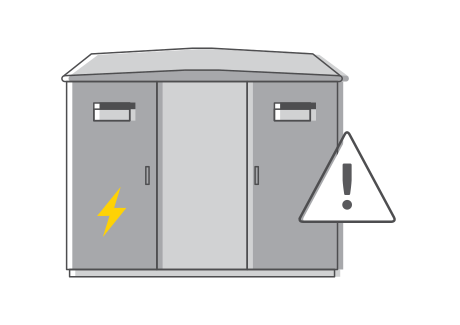
In this case, a property owner wanted their electricity supply to be upgraded and had concerns about the quality of electricity flowing through a transformer that was supplying electricity to the property. They believed it was responsible for voltage spikes, outages, and damage to electrical appliances. There were no clear records of who owned the transformer and whether it was the electricity network operator or the property owner.

The parties disagreed about previous upgrade work and who was responsible for the current state of the transformer.

The electricity network owner performed some testing and mitigation work, including adjustments to the transformer. There were some records of signage on the transformer which suggested the transformer was owned by the property owner, however it was confirmed the network owner had subsequently incorporated the transformer into its network.

The network operator made an offer of compensation to the property owner which was rejected.

What did we look at?

The Commissioner considered the standards of electricity supply and voltage the property owner should expect to receive from the transformer. Utilities Disputes also looked into the ownership records for the transformer and how this affected liability for its maintenance and performance. When it was confirmed the electricity network owner was responsible for the transformer, the Commissioner considered whether the offer of compensation was sufficient to address the issues raised by the complaint.

What was the outcome?

The Commissioner accepted that voltage fluctuation and outages can occur within acceptable limits. However, in the present case these issues had been exacerbated due to the prolonged dispute about ownership and gaps in official records. The network owner’s eventual acceptance of responsibility for the transformer, additional work on it, and compensation offer was sufficient to address those issues and resolve the complaint.

Names and details have been changed for privacy reasons.

Impersonation scams and refunds

Impersonation scams are common as scammers also target utility customers. Companies can reduce the risk to their customers by issuing regular reminders and warnings as well as adding controls around payments.

In this case, a customer was contacted by a scammer who claimed to represent a well-known price comparison service and was offered a promotion. The ‘promotion’ required the customer to pay $350 to the comparison service and the customer could gain a $500 credit into their water services account.

The scammer then arranged for a $500 payment to be made into the customer’s water account from a fraudulent credit card.

The customer contacted their water services provider to check that the $500 payment was in their account, but did not provide the full details of the conversation with the scammer. The customer then transferred $350 to the account provided by the scammer.

The water services provider subsequently identified the $500 payment was fraudulent, and reversed the payment. The provider advised the customer to pursue the scammer through their bank, but it was too late to recover the $350. The provider also introduced stronger customer-facing scam warnings.

What did we look at?

The Commissioner considered whether the water services provider had sufficient information to warn customers about the potential scam. We then considered the circumstances of the complaint and how the provider engaged with its customers.

What was the outcome?

Based on the information available at the time, it was not reasonable to expect the provider would identify the scam before the customer made the $350 payment. The provider correctly identified the fraudulent $500 payment and provided appropriate guidance once the scam was identified.

The provider also introduced additional preventative warnings to its customers. Utilities Disputes contacted the legitimate price comparison service and our members to let them know about the scam so they could warn customers and share information. We added an information page on our website information and a notification in our newsletter at that time.

Names and details have been changed for privacy reasons.

Performance standards

Performance standards

Time to close cases

Performance Standard A

90% of all cases closed within 10 working days
>90%
Met
91%
65% of complaints closed within 30 working days of deadlock
>65%
Not met
58%
90% of queries closed within 1 working day
>90%
Met
93%
90% of complaints closed within 90 working days of deadlock
>90%
Met
93

Complainant satisfaction

We survey complainants for different parts of our process which can be broadly divided into early resolution and conciliation work, the surveys include questions around ease of use, respect, understanding, and timeliness.

Our overall complainant satisfaction scored an average of 4.20 out of 5 for the 2025–26 year.

Performance Standard B

Goal: reaching an average of 4 out of 5
4 out of 5
Met
4.20

Provider satisfaction

Provider satisfaction is monitored in the same way as complainant satisfaction. We survey providers at the point where a complaint concluded throughout our process. Our provider satisfaction scored an average of 4.49 out of 5 for the 2025–2026 year.

Performance Standard C

Goal: reaching an average of 4 out of 5
4 out of 5
Met
4.49

Net Promoter Score

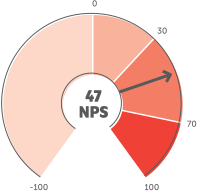
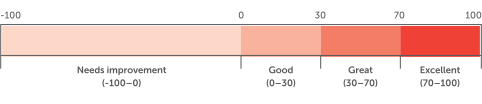
NPS stands for Net Promoter Score and is a widely used market research metric measuring customer loyalty, satisfaction, and enthusiasm by asking how likely they are to recommend a company’s product or service to a friend or colleague. Scores range from -100 to +100. A positive score is generally considered good, while a score above 70 is excellent.

Our NPS is 47 which is considered great.

graph net promoter score

What is a good NPS score?

Awareness and accessibility

The new performance standard for awareness and accessibility is 25% unprompted recognition in the MBIE bi-annual consumer survey.

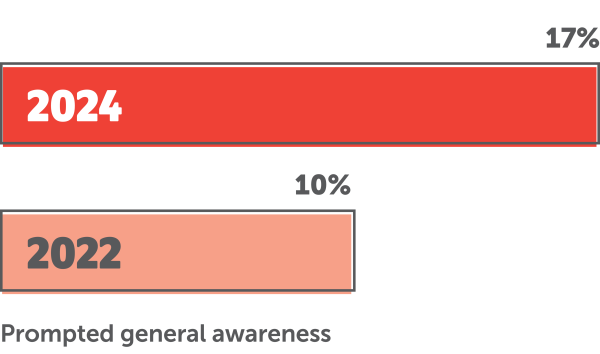
As reported above the MBIE consumer awareness survey is carried out every two years. It was last reported in 2024 and UDL scored 17% for prompted general awareness, this compares with 10% in 2022 and 9% in 2020. MBIE will publish its next survey in late 2026.

UDL promotes accessibility by translating aspects of its website and key resources into Te Reo Māori, supporting complainants with language and communication needs and through its significant engagement and work with the community organisations that support and assist Kiwi consumers.

Performance Standard D

25% prompted awareness in the bi-annual MBIE consumer survey

Bar graph showing 17% in 2024 and 10% in 2022

Compliance reporting for the Energy Scheme

The Board monitors provider compliance with the Scheme. UDL’s annual self-review of compliance is scheduled to be completed in June 2026, the previous self-review of compliance was completed in June 2025.

Performance Standard E

Compliance reporting for the Energy Scheme is complete, accurate and on time

Met

External review of cases

A selection of cases were reviewed by Professor Ron Paterson ONZM. He was asked to consider whether:

  • UDL is meeting its purpose and correctly applying the legislative requirements and rules of its approved schemes.
  • UDL is correctly applying the principles of accessibility, independence, fairness, accountability, efficiency, effectiveness, the rules of natural justice.
  • UDL’s approach to early resolution to resolve consumer complaints is appropriate for a modern dispute resolution provider.

Professor Paterson was also asked to provide any general feedback and recommend any areas for improvement identified in the review. The review was positive with Professor Paterson confirming we are generally meeting the above objectives, with an overall score of just over 90% when marks are aggregated. The Deputy Commissioner has shared the report with operational managers and is looking at any areas of suggested improvement.

Performance Standard F

Assess complaint handling as meeting requirements of natural justice and good complaint handling

Met

Community

Te Ao Maori and Te Tiriti o Waitangi strategy

Our Te Ao Māori journey never stops. Selwyn Lackner-Priest our Māori Cultural Advisor moved on during the year to lead a project close to his heart nearer home in Taranaki.

Ron Taukamo joined us late in 2025 giving us the opportunity to reflect, review and refresh our four strand approach that we focused on for this financial year.

Four weave approach

Strand one – Te Reo Māori
Strand two – Tikanga
Strand three – Te Tiriti o Waitangi | Treaty of Waitangi
Strand four – Kanohi Kitea | Physical presence in the community.

We continued to weave these strands using a number of approaches that incorporated these principles:

Partnership | Whakarangapū

Mana Whenua is the principle which defines Māori by the land occupied by right of ancestral claim. It defines tūrangawaewae (a place to stand) and ūkaipō (source of sustenance) the places where you belong, where you count, where you are important, and where you can contribute. Mana whenua is essential for Māori wellbeing. The places Māori find themselves, their strength and energy, are where Māori have mana whenua. We are committed to the pursuit of respecting mana whenua.

Whanaungatanga underpins the social organisation of whānau, hapū, and iwi, and includes rights and reciprocal obligations consistent with being part of a collective. It is the principle which binds individuals to the wider group and affirms the value of the collective. Whanaungatanga is inter-dependence with each other and recognises that the people come first. We are committed to embodying whanaungatanga throughout all our Māori engagements.

Participation | Whakaurunga

Manaakitanga is the behaviour that acknowledges the mana of others as having equal or greater importance than one’s own, through the expression of aroha, hospitality, generosity, and mutual respect. In doing this, all parties are elevated, and our status is enhanced, building unity through humility and the act of giving. We are committed to ensuring that manaakitanga is at the forefront of our engagements with Māori.

Kotahitanga is the principle of unity of purpose and direction. It is demonstrated through the achievement of harmony and moving as one.

Our staff are encouraged to work with consumers and providers to resolve the conflict at hand. We are committed to ensuring that unity guides the resolutions we are involved in with Māori.

Protection | Whakamaru

Rangatiratanga is the expression of the attributes of a rangatira (weaving the people together) including humility, leadership by example, generosity, altruism, diplomacy, and knowledge of benefit to the collective. As an organisation, the importance of following through on commitments with integrity and honesty, is essential. As a people, rangatiratanga is reflected in the promotion of self-determination for Māori, and an expression of the rights defined by mana atua, mana tūpuna, and mana whenua. We are committed to ensuring that the rangatiratanga of Māori is upheld in all engagements with Māori.

Kaitiakitanga embraces the spiritual and cultural guardianship of Te Ao Mārama (“the world of light” or “the enlightened world”) a responsibility derived from whakapapa. Kaitiakitanga entails an active exercise of responsibility in a manner beneficial to our various environments for the welfare of the collective. It promotes the growth and development of the Māori people in all spheres of livelihood so that Māori can anticipate a future of living in good health and in reasonable prosperity. We are committed to promoting and maintaining kaitiakitanga in our engagements with Māori.

We focused on internal and external activities that continue us on our journey with examples below.

Internal 

  • Weekly Te Reo classes.
  • Training – activities that help us understand Te Ao Māori and what that means in our lives at work and outside of work. During Matariki week we held two workshops on flax weaving of stars led by Toumairangi Fowlie and Selwyn using Pōneke prepared flax with the results displayed on our staff room wall.
  • Offering of tikanga based mediation.
  • Ongoing Te Reo translation of the website.

External

  • Waitangi Day collaboration.
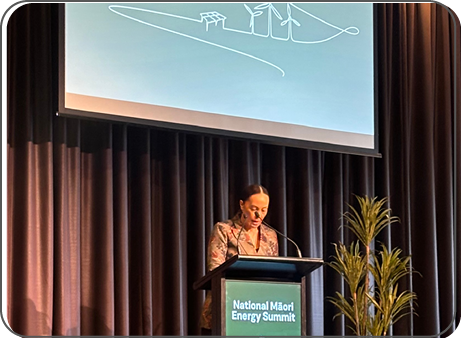
  • Attending National Māori Energy Summit.
  • Our pilot in Waitara using a local office as a drop in for guidance and support on utilities disputes resolution.
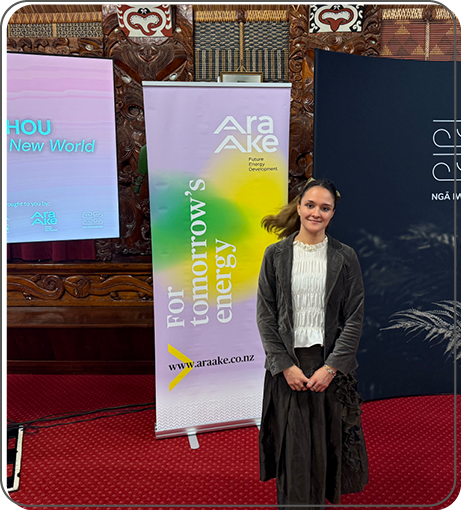
  • Participating in the Ara Ake Conference.
  • Presenting and attending events at marae across the motu including Owae and Otara Maraes.

Presenting at the National Māori Summit

Participating in the Ara Ake Conference.

Community engagement

Our community engagement is driven by a key principle: you can only “go at the speed of trust in that community”. Two years ago, we developed a community engagement framework to help us measure and navigate the community engagement we do. Over time we have moved from outreach to considered engagement. It is all about the people and the community – our time is their time which helps us build trust which is the currency of any community.

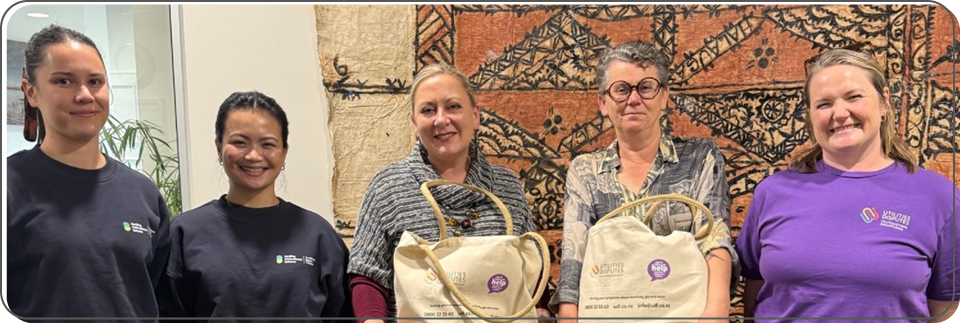
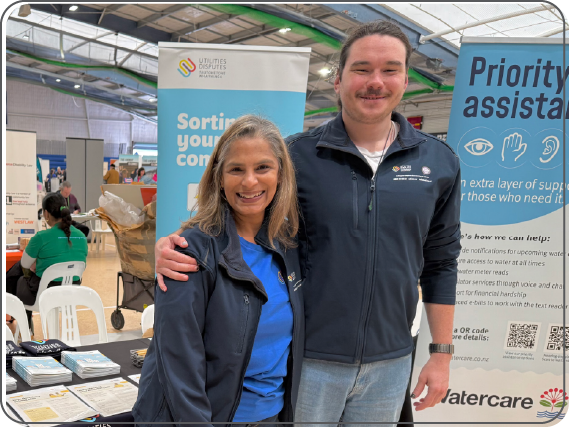
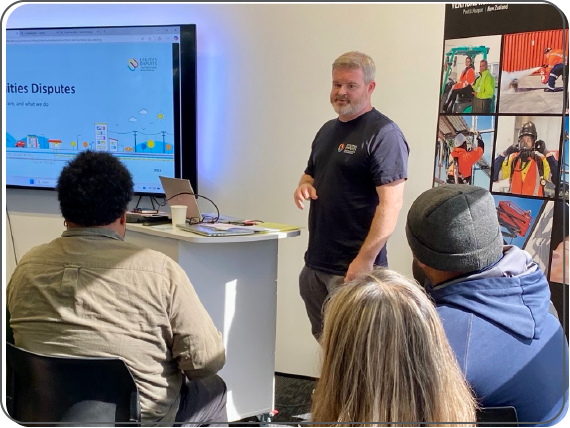
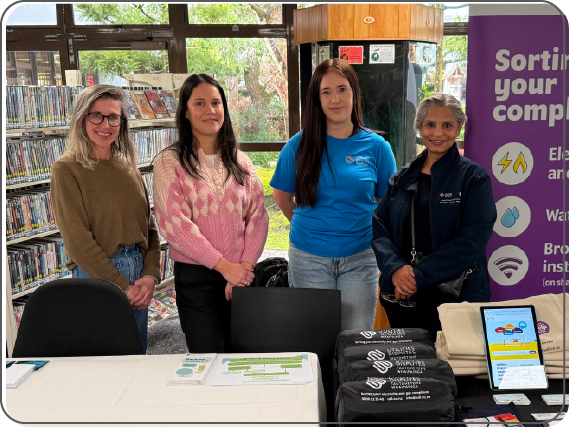
We have a community engagement officer based in Auckland and we draw on the resources of the wider Utilities Disputes team for roadshows and events such as Waitangi Day, University Orientation weeks or Expos like the Disability Conference and monthly events.

This year we ran two roadshows with the Banking Ombudsman with events in Porirua and across the South Island from Invercargill to Timaru. We also ran a community pilot in Waitara to reach out to the wider Māori community in Taranaki building on relationships we have built over recent years. These events are always an opportunity for us to engage and build relationships and oftentimes partnerships with organisations that we meet with more frequently.

This year Jessica alone met with 234 organisations either in person, online or at events and she regularly connects with key community organisations at events. Other staff attended events in Porirua and Wellington including Pasifika networks and Age Concern.

What we do is simple. We engage with the community so that they can see themselves in what we do and have the confidence to refer consumers to us when they need our services. We also listen and provide education aimed at reducing complaints through presentations and discussion. At the end of the day it’s about consumers knowing who to come to when they need help sorting a utilities dispute. If people don’t know about us then we cannot help them and their utility provider.

Digital engagement

Our community engagement goes from strength to strength as our awareness continues to rise. We have worked hard to increase consumer awareness and accessibility to our services over the past year, running a social media campaign during winter so people know they can come to us for help. We also linked with the Electricity Authority on a separate campaign to raise awareness of its consumer care obligations and the fact consumers could come to us to resolve their issues and complaints.

Digital campaigns 

a) Social media campaign from July to December using Meta, Facebook, and Google ads platform

Results showed increasing Utilities Disputes visibility with 9,380,000 total impressions and an increase of 145% in website sessions.

b) Dual social media campaign from July to December

This dual campaign with the Electricity Authority also increased our brand visibility with impressions of 10,500,000+ on the YouTube, TVNZ+, Māori TV, Stuff and NZME platforms, significantly increasing our reach on platforms we do not engage with on a day-to-day basis.

9M+
total impressions from single social media campaign

Impressions means the number of times our website link, ad, or content appeared on a user’s screen in Google services (eg: Search, Maps, or YouTube). Impressions tracks visibility which means it counts every time our content was shown.

Website

Our website reach is increasing from website views this year at 119,516 up from 80,872 (48% increase). This is due to the social media campaigns and our ongoing community engagement.

Our engagement rate at 56% was 2% higher than the previous year and means that more than half of all sessions included engagement from the user. As a general principle this is considered a ‘solid’ performance.

We also have on the website the ability to fill in a complaint form (call to action) with 417 interactions and will be looking to increase this in the coming year.

48%
increase in website views

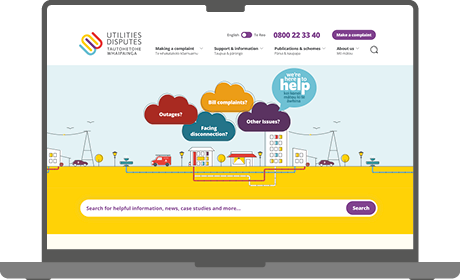
Computer laptop showing homepage of Utilities Disputes website

Providers

Annual Forum

We started the year off in April 2025 with our Annual Forum at Te Papa. Our theme was ‘Keep Calm and Carry on Resolving’ with sessions on handling challenging behaviour from a recognised expert in the field, data and insights, practical AI, privacy and tech, and cultural competency.

The highlight was a panel session ‘It Takes a Community to Resolve a Complaint’ which looked at how Utilities Disputes, providers, community organisations and key stakeholders worked together to resolve complaints and assist vulnerable consumers. The panel included staff from Contact, Mercury, Watercare, FinCap, Toast Electric and a representative from the Ministry of Social Development’s power team. The session was facilitated by our community engagement officer and was a positive example of how everyone can work together to resolve issues.

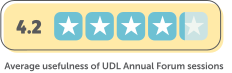
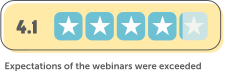
Feedback from the event was excellent. Overall, the average feedback on all sessions was 4.2 out of 5.

graph providers annual forum 2

Webinars

We have seen a recent increase in registrations and attendance at webinars, particularly in community organisation attendance.

  • May: Challenging Behaviours (220)
  • July: Ministry of Social Development’s Power Team and Role in Energy Hardship (187)
  • August: Energy Support for Households, Energy Retailers & Generators Association NZ (182)
  • September: Mental Wellbeing in Complaint Handling, Robyn Bradey (197)

The webinars averaged 195 registrants with less viewing on the day as people register to watch later with their teams as training exercises. More community organisations are joining our sessions, and we hope to continue to expand these.

After each webinar we send out a feedback form. The responses this year were very positive, as shown in the below infographic.

Externally, Utilities Disputes staff also participate in external webinars. They were involved in a webinar for FinCap, in which we discussed how we work and when they should refer consumers to us. This aligns with an objective set last year to start engaging in specialised webinars for community groups and social services. We also undertook a ‘closed’ session for community Advice Bureau (CAB) staff so they could ask ‘safe’ questions and questions specific to the work they do.

graph providers webinars 2

Newsletters

Newsletters remain one of our primary channels for communication with providers, with organisational updates, details of upcoming events, training and other information.

We published eight newsletters with an audience largely comprising providers, however many consumers and social service workers are also registered. Early in the year we combed the audience to remove bot traffic, which reduced our audience from over 1,500 to near 1,100 – since then, we have experienced moderate growth to return to 1,300 subscribed contacts.

This reporting period we continued with a structured approach including a staff profile (always popular), data-driven article, training promotion, community engagement and case study in every newsletter.

1,300
subscribers to our newsletter

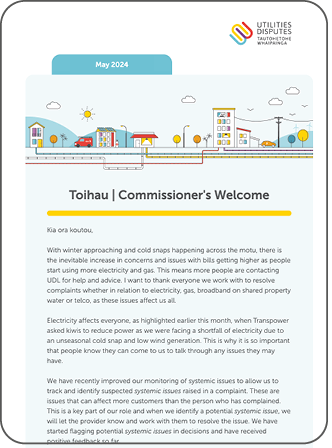
Utilities Disputes newsletter

External training in complaint resolution

We also deliver tailored training for our providers’ complaint resolution teams, aimed at increasing their ability to recognise, manage and resolve complaints. There are three training levels available, exploring different techniques and tools that help manage complaints:

  • Level one is an introduction to recognising and resolving a complaint (free)
  • Level two focuses on how to deal effectively with difficult behaviour
  • Level three is an advanced negotiation skills and complaint process design workshop.

We provided nine Level One training sessions and six Level Two training sessions to a total of eight member organisations. This is an increase from last year and is the most Level two training sessions we have ever provided. We refreshed our offering during the year as we are committed to continuing to grow this service.

External trainers, Caitlin and Trevor

Our external trainers, Caitlin and Trevor

Submissions

We have continued to make submissions on consumer issues in discussion papers, bills and any regulatory changes that touch upon our areas of expertise and knowledge. We also take the opportunity to deliver presentations that highlight the work we do and the benefits of good dispute resolution. We have received compliments about the quality and value of our submissions and that we should continue to work in this area as it does make a difference.

Submissions made during the year included:

Electricity Authority

  • Working Together to Ensure Our Electricity System Meets the Future Needs of all New Zealanders
  • Our Future is Digital
  • Evolving Multiple Retailing and Switching
  • A Regulatory Roadmap for Battery Energy Storage Systems Paper
  • Enabling Consumer Mobility by Improving Access to Electricity Product Data
  • Energy Competition Task Force Work Programme
  • Improving Access to Electricity Product Data
  • Improving Billing
  • Reducing Barriers for New Connections
  • Energy Competition Task Force Work Programme

Ministry of Regulation

  • Terms of Reference for Regulatory Review of the Telecommunications Sector
  • Changes to the telecommunications industry

Commerce Commission

  • Improving Retail Quality: Switching
  • Foundational Information Disclosure for Wellington
  • Economic Regulation of Water Services – Information Disclosure (Draft Decision)
  • Feedback on Default Price Pathway

MBIE

  • Tree Risk Assessment Factors
  • Amendments to the Fair-Trading Act 1986
  • Proposals for an Electricity Sector Consumer Data Right

Other

  • Consumer Care Guidelines – The Gas Company
  • Water Research Roadmap – Water NZ
  • Econ & Dev Select Committee, Telecommunications Amendment Bill

The Commissioner, Deputy Commissioner and Legal and Policy Officer appeared before the Select Committee to comment on the Consumer and Product Data Bill on 19 September 2024. We also appeared before the Finance and Expenditure Committee at the Select Committee hearing into the Local Government (Water Services) Bill on 6 March 2025 to talk to our recent submissions. While dispute resolution appears to be a low priority in the sector at present, this will provide an ideal opportunity to push the merits of what we can offer.

Systemic Insights Report

As indicated above, one significant piece of work undertaken with stakeholders involved the identification of systemic issues around back bills, and efforts to address these. We identified the need for greater consistency amongst electricity retailers around how far back they can go when issuing a back bill.

We raised the issue with the Electricity Authority and some retailer CEOs directly highlighting inconsistent approaches, some covering years of accumulated charges, which were unfair in our view and causing avoidable financial shock and distress for households and businesses alike. The work led to the Electricity Authority introducing restrictions that will prevent retailers going back more than six months. We also submitted for retailers to have some standardised billing information on bills which was also used by the Electricity Authority to introduce changes to bills and new standardised requirements. You can read the case study on page 14.

Our people

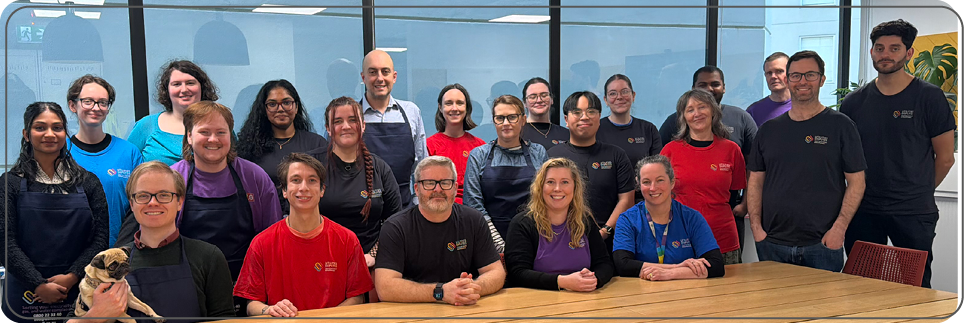
It has been a challenging year, and our staff continue to meet that challenge as well as supporting and looking out for each other – a key part of our culture.

Growth

Due to the increased demand for our services, we grew from 38 staff and contractors to 46. The increase was in our operational teams and a direct response to the growth in complaints we received.

500%
increase in the number of complaints

Over the past five years, we have seen complaints increase by over 500% due to a combination of increased awareness, rising energy prices and cost of living pressures. We raised productivity by over 67% over this time, increasing our complaints to staff ratio by 167% and decreasing costs to complaint ratio by 60%.

At the same time, we have maintained high customer satisfaction scores and retained our average days to close a complaint due to the professionalism of our people. This year required a higher investment in people to ensure we were sufficiently resourced to deliver our core services and look after our people.

Staff engagement

We measure and track staff engagement with Gallup and have done so since 2018.

Our overall employee engagement was 4.36, putting us in the 70th percentile of our industry. The feedback was overwhelmingly positive and reflective of our supportive culture. Comments and feedback provided will be used to identify areas where we can improve on and how we can continue to make Utilities Disputes a great place to work.

I think this is the best group of people I have ever worked with. We are different ages and backgrounds but have a common purpose and look out for each other.

You are empowered to do your job.

Training

We provided training throughout the year, including sending new operational staff on the Resolution Institute’s five-day mediation training course. We also provided Self-Safe training and workshops on mental health and managing challenging behaviours.

We have one staff member accredited to provide tikanga based mediation through the Resolution Institute. It means we are one of the only services of our kind with accredited tikanga based mediators inhouse in Aotearoa. Tikanga training was also provided across the organisation and we continue to provide Te Reo Māori classes for staff.

The Self-Safe training is focused on personal safety, with a particular emphasis on de-escalation techniques for our office workers not based at head office. An adapted version of the training, aimed at dealing with threats both in person and over the phone, was provided to all remaining staff. Additional staff received training on the use of duress alarms to enhance workplace security. This training aligns with our commitment to ensuring a safe working environment, particularly for those in higher-risk roles.

Staff also continue to receive learning inhouse on energy, telecommunications and water to keep up to date with the latest developments.

Staff benefits

UDL’s Parental Leave Policy allows a primary carer to have their government payment topped up to their full ordinary UDL salary for the 26-week entitlement. It was accessed by three staff members. One staff member also accessed the additional leave provided for the non-primary carer.

Staff were also able to continue to access the Bonusly recognition programme. Bonusly is a popular peer-to-peer employee recognition and rewards platform designed to increase employee engagement, improve retention, and foster a culture of appreciation. It allows staff to publicly celebrate accomplishments, share, and give small, monthly, value-aligned monetary bonuses, which can be redeemed for rewards such as gift vouchers, cash, or donations.

There is always help if you need it from anyone within the organisation. Everyone is approachable and happy to lend a hand.

We are encouraged to think outside the box, and bring our best selves every day.

For the year ended 31 March 2026

Financials

All schemes

Annual levy 5835911
Other income 174789
Total income
Staff related costs 4143346
Other costs 1872584
Depreciation 191131
Operating surplus before tax -196361
Total expenditure
Budget 6031089

Energy

Energy
Annual levy 5511747
Other income 166894
Total income
Staff related costs 3934499
Other costs 1788000
Depreciation 182498
Operating surplus before tax -226356
Total expenditure
Budget 5758666

Broadband Shared Property Access Disputes

Broadband
Annual levy 260583
Other income 6098
Total income
Staff related costs 166420
Other costs 65329
Depreciation 6668
Operating surplus before tax 28264
Total expenditure
Budget 210408

Water

Water
Annual levy 41818
Other income 1273
Total income
Staff related costs 26913
Other costs 13633
Depreciation 1391
Operating surplus before tax 1154
Total expenditure
Budget 43908